

Hello! October’s newsletter has a never-before-seen essay and first-look news and happenings, just for you. Read to the end for all that’s happening (a lot!) Thank you so much for your support!
Essay
I, Sensor
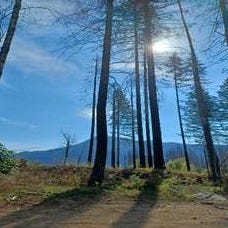
In fall of 2022 I was invited to a gathering of environmental writers and thinkers at the H. J. Andrews Experimental Forest in the Cascade mountains or Oregon. The forest, which makes up just one percent of the Willamette National Forest, had nearly burned in the 2020 Holiday Farm Fire.
The group, convened by Oregon State University’s Spring Creek Project, spent three days in a sliver of old growth surrounded by burned private and working public timber lands grappling with questions of deep ecology and what it means to study an ancient forest on human timescales. That the Andrews is a place of science is everywhere apparent; ancient trees are garlanded with wires and meters, plastic buckets collect debris, investigative plots are dellineted with PVC pipe and plastic string, everywhere you look, something is being measured. One participant, Professor David Syring, the Chair of the University of San Diego Anthropology Department, asked us each to write about the concept of the sensor as it applied to our experience of active science in that fragile, ancient place.
This was my response:
Superiority and dominion hinge on the human capacity to act as a sensor. I sense, therefore I am.
In sensing, we stand apart, we argue. Sensing is our consciousness, we say, and it is that, our capacity to observe, register, and, by extension, bring meaning to a thing, that sets us apart from the rest of the natural world. It is our superior ability to sense, we claim, that grants us inalienable rights that do not extend beyond our species. We sense, therefore we rule.
But what difference is there, I ask, between my body sitting curled and naked, knees against my chest in the waters of a cool stream and the stone that sits beside me? Do we not both hold our place by sensing the forces of friction and gravity upon our masses? Does the cool stream not register against my flesh as it does the surface of the stone? Does its body not warm in the sun and cool at dusk as mine? The action of wind and water will leave their mark across our surfaces. Time will register on both our faces, wearing and eroding our youth. The stone, rounded and shaped by its travels from atop the mountain, has preserved in physical form at least as much of its history as I retain in my feeble and imperfect memories. Surely the stone can, and will, persist in the stream long after my tender flesh has had its fill and surrendered to the shore.
And what of the old growth tree that stands beside me on the trail, abiding, as it does, the rain and wind? It towers above me as I huddle under its dancing limbs in search of shelter. It has stood in this place for hundreds of years, building a structure of cambrium and bark, recording in its growth rings the relative conditions, years of plenty, years of fire and drought, that have brought it to its place of dominance. My body keeps no such record.
If the stone is a sensor, what becomes of our superiority? If the tree is a sensor, how are we to wield the axe of our dominion? It will not do.